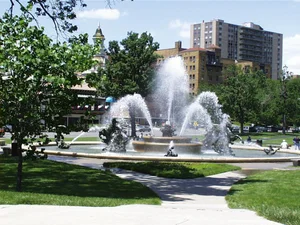
Fountain Day in Kansas City: When the Water Flows, Spring Is Finally Here
By Cindy DiCianni, CRS | RE/MAX State Line | Johnson County, KS Real Estate
There is a moment every April in Kansas City that feels less like a calendar event and more like a collective exhale. The fountains come back on. Water arcs into the air across more than 200 locations throughout the metro, the sound carries across parks and plazas and tree-lined boulevards, and without any official announcement, everyone seems to sense the same thing: winter is done, and this city has woken up again. That moment is Fountain Day, and if you have lived here long enough, you know it matters in a way that is genuinely hard to explain to people from somewhere else.
For those of us who work and live in Johnson County, Fountain Day is also a natural reminder of why people choose this part of the Kansas City metro, and why, year after year, buyers from across the country relocate to Overland Park, Leawood, Lenexa, and the surrounding communities. The quality of life here is not accidental. It is built into the bones of the place, and the fountains are part of that story.
A City That Takes Its Fountains Seriously: The History Behind Fountain Day
Kansas City's relationship with fountains goes back to the late 1800s, when the first water features were installed for entirely practical reasons, offering drinking water for horses, dogs, and the people passing through a rapidly growing city. George Kessler, the landscape architect who designed much of Kansas City's park and boulevard system, installed the first city-built fountain in 1898 at 15th and The Paseo, and the one that followed that same year is now known as the Women's Leadership Fountain and still flows today as the oldest operational fountain in the city.
What happened next was something beyond utility. Developer J.C. Nichols began incorporating European-style fountains and sculpture into his Country Club Plaza development in the 1920s, and the City Beautiful movement took hold in a meaningful way. Fountains became art, and then they became identity. By 1973, Kansas City had earned a reputation significant enough that a Hallmark executive and his spouse returned from a trip to Rome troubled by what they had seen: thousands of Italian fountains in various states of disrepair. They came home and founded the City of Fountains Foundation, with a mission to ensure Kansas City's water features were preserved, maintained, and celebrated for generations to come.
Today the metro claims more than 200 registered fountains, making Kansas City second only to Rome in fountain count, and unlike many of Rome's aging structures, ours work. Every spring, Kansas City Parks and Recreation and the City of Fountains Foundation mark the occasion with a formal ceremony, remarks from the mayor and city council, and the ceremonial activation of the fountains. In 2026, that ceremony took place on April 15th at the Laura Conyers Smith Municipal Rose Garden Fountain in Loose Park, with a live performance by Fountain City Strings and the fountains running through mid-October.
Rome Built an Empire. Kansas City Built Something to Live In.
The Rome comparison is not just civic boosterism, though Kansas Citians do enjoy saying it out loud. There is something real in the parallel. Rome used fountains as expressions of power, engineering achievement, and civic pride, and the water flowing through the Trevi Fountain or the Fontana dei Quattro Fiumi in Piazza Navona was never just about water. It was about what a city believed about itself.
Kansas City landed in a similar place through a different path. The fountains here were not built by emperors. They were funded by developers, school children collecting pennies, private foundations, civic organizations, and neighborhoods that wanted something beautiful at their center. The Mill Creek Fountain near Country Club Plaza, one of the most photographed landmarks in the city, was sculpted in Paris in 1910, originally adorned a millionaire's estate in New York, and was brought to Kansas City in 1951 through a combination of city funding, the Nichols family, and donations from area schoolchildren. That combination of sources matters. It means the fountains here belong to everyone.
The four horsemen on the Mill Creek Fountain represent the Mississippi, the Volga, the Seine, and the Rhine, four of the world's great rivers, standing in the middle of the American heartland. That is not an accident of history. It is a statement about the kind of city Kansas City has always wanted to be: cosmopolitan, beautiful, and rooted in something that lasts.
Why Beauty in Public Space Actually Matters
There is research behind what feels intuitive to anyone who has ever slowed down near a fountain. The sound of moving water lowers cortisol. Shared public beauty creates what urban planners call social cohesion, which is the technical term for neighbors feeling connected to each other and to the place where they live. Communities with well-maintained public spaces see higher civic participation, stronger property values, and lower rates of what researchers call social fragmentation.
This is part of why Johnson County consistently ranks among the most desirable places to live in the entire country. The quality of life here is not accidental, and it is not exclusively about school ratings or highway access or new construction, though all of those matter. It is also about the care that goes into the shared environment, the trails that connect neighborhoods, the parks maintained to a high standard, and the fountains that come on every April and stay on until mid-October because a city decided that beauty was worth investing in.
When buyers relocate to Overland Park or Leawood from Dallas or Denver or Chicago or the coasts, they often tell me they are surprised by how much they like it here. What they are usually discovering is that the quality of life in Johnson County is not marketed loudly enough. The fountains are part of that story. So are the trails, the parks, the restaurants along 119th Street, the Blue Valley schools, and the neighborhoods where people actually know their neighbors. Fountain Day is one morning each April, but what it represents is something that exists here year-round.
Fountains You Will Actually See in Johnson County
The most famous KC fountains are concentrated in Kansas City proper, and they are worth the drive. The Mill Creek Fountain near Country Club Plaza and the Neptune Fountain at 47th and Wornall are two of the most recognizable, and the Henry Wollman Bloch Fountain near Union Station draws visitors year-round. The Crown Center Square Fountain, with its jets choreographed to Kansas City Symphony recordings, is especially popular with families.
Closer to home, Johnson County residents live among their own collection of water features that anchor the landscape. Corporate Woods Founders' Park in Overland Park, situated in the 52-acre green space off College Boulevard near I-435, features a substantial fountain at its center along with trails, picnic areas, and access to Indian Creek, and it has become a gathering point for the employees and residents who live and work in that corridor. The Fountains at 119th Street in Leawood, one of the area's most distinctive retail and dining centers, takes its name and its identity from the water feature at its core, and it is the kind of place where people linger on a spring evening precisely because the environment invites it.
Throughout Overland Park's parks system, including Antioch Park, Heritage Park, and the trail corridors along Indian Creek and Tomahawk Creek, water is woven into the landscape in ways that reward the people who spend time there. Many of the newer mixed-use developments along the 119th and 135th Street corridors have incorporated water features deliberately, because the developers understand what the research confirms: people pay attention to beauty, and they stay where they find it.
What Fountain Day Has to Do with Buying or Selling a Home in Johnson County
Every spring, right around the time the fountains come back on, the Johnson County real estate market enters its most active stretch of the year. Buyers who have been watching listings since January start moving. Sellers who waited out the winter start calling. April and May typically see the highest showing activity, the most competitive offer situations, and the strongest pricing, particularly in Overland Park neighborhoods with good school access and trail proximity.
Fountain Day is, in that sense, as good a signal as any that the season is open. If you are considering a move, whether you are buying your first home in Johnson County, relocating from another market, or thinking about listing a property you have owned for years, this is the time of year when your options are widest and buyer interest is highest.
Overland Park homes priced between $400,000 and $700,000 move quickly in this window, and properties near parks, trails, and the 119th Street and 135th Street corridors consistently hold value well because the lifestyle infrastructure around them is real and visible. Buyers from out of state who tour these neighborhoods in April often comment that the city looks better than the photos, and that is exactly the point. The fountains are on. The trails are filling up. The restaurants have opened their patios. Johnson County in spring is genuinely beautiful, and that beauty is not just a selling point. It is a reason people stay for decades.
If You Are Thinking About a Move, This Is the Right Time to Start the Conversation
I have been selling homes in Johnson County for more than 35 years, and I can tell you that the people who are happiest with their decisions are the ones who understood what they were choosing beyond the square footage and the school rating. They chose a place where the parks are maintained, where the neighborhoods have character, where the shared spaces are worth sharing, and where
If you are considering buying or selling in Overland Park, Leawood, Lenexa, Olathe, or anywhere in Johnson County, I would love to talk through what that looks like right now. The market is active, inventory is moving, and spring is the season when buyers are most engaged and sellers have the most to gain.
Reach me at 913-312-3614 or 913-430-8922. email: Cindy@CindyDTeam.com, and visit our website: www.CindyDTeam.com for current listings, neighborhood guides, and more information about living in Johnson County, Kansas.